
Where the Phoenix Rises: CPG Leads Design of Phú Quốc International Airport’s New Passenger Terminal
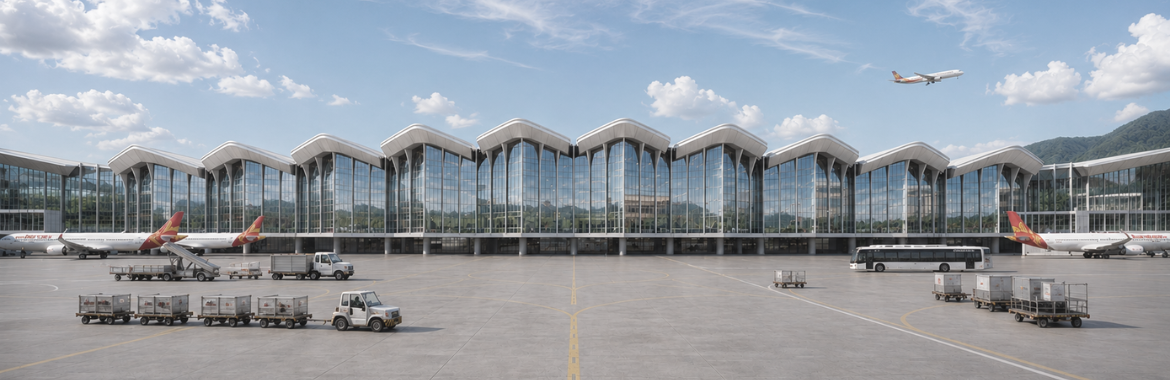
A World-Class Vision for the Pearl Island’s Gateway
Vietnam’s tourism sector marked a milestone year in 2025, with international arrivals reaching nearly 21.2 million, an indication of the sector’s strong recovery and how the country continues to be one of Southeast Asia’s popular tourism destinations. In turn, this places greater emphasis on airports as critical gateways, not just for accommodating visitor capacity and connectivity, enhancing user experience, and driving economic growth.
Amidst the strong growth and evolution of Vietnam’s aviation infrastructure, the expansion of Phú Quốc International Airport represents a pivotal moment. With projections of an increased operational capacity, and the “Pearl Island” preparing for global events such as the APEC 2027, the Phu Quoc International Airport Expansion Investment Project, which is commissioned by Sun Group, aims to shape the Phu Quoc airport into a smart, world-class aviation hub.
As the appointed Lead Design Consultant, CPG Consultants brings deep aviation and urban development expertise to the Phú Quốc International Airport project, drawing on its involvement across multiple phases of Singapore Changi Airport’s Terminal 1, 2, and 3 developments over the decades. The project design is led by Steven Thor, Executive Vice President (Global), Global Atelier Collective at CPG Consultants. The Phu Quoc passenger terminal will integrate modern, sustainable architectural design and terminal planning that is underlined by operational efficiency and long-term scalability.
A Cultural Narrative in Flight
At the core of the design is a powerful narrative inspired by the phoenix, an enduring symbol in Vietnamese culture representing rebirth, strength, and prosperity. Rather than applying this symbolism superficially, the design team sought to integrate it meaningfully into the architectural language and spatial experience of the terminal.
As such, the Phoenix motif has been translated into the terminal’s façade and roof structure. The elevated roof tip creates the image of a Phoenix spreading its wings and soaring into the sky.

“The phoenix as a design inspiration reflects not only a powerful cultural symbol for the Vietnamese people, but also the aspirations of Vietnam and Phú Quốc as they rise on the global aviation stage.”
Steven Thor, Executive Vice President (Global), Global Atelier Collective at CPG Consultants
Natural light will illuminate the nearly 36-metre-high main hall and open up expansive views, creating a bright, open interior space that enables passengers to immediately feel the natural beauty and identity of Phu Quoc from the moment they arrive. This design approach is intended to most fully express the beauty of the island.
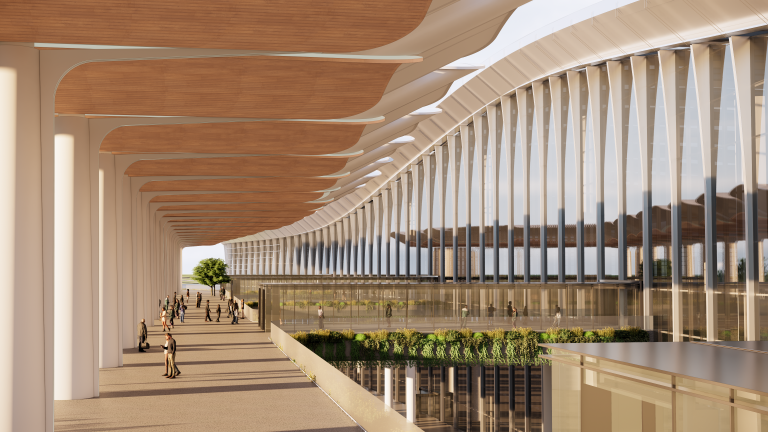
Phu Quoc’s natural harmony of sea, sky and land is thoughtfully translated into the airport’s material and colour palette. The terminal is organised across multiple levels that reflect these natural layers: the departure level evokes the sky through lighter tones, the central level reflects the island landscape with warmer hues, and the arrival level draws from the sea with cooler tones. Together, these create a spatial narrative that mirrors the essence of Phu Quoc through colour and form.
Designing for Movement
While the architectural expression is striking, the project is fundamentally grounded in a rigorous approach to operational planning and passenger experience. The design adopts a passenger-centric strategy that prioritises clarity of movement, efficiency, and adaptability.
A key planning principle is the segregation of departure and arrival flows across different levels, ensuring intuitive navigation while maintaining operational security and efficiency. This vertical organisation is complemented by clear sightlines and visual connections, enabling passengers to orient themselves easily within the terminal.
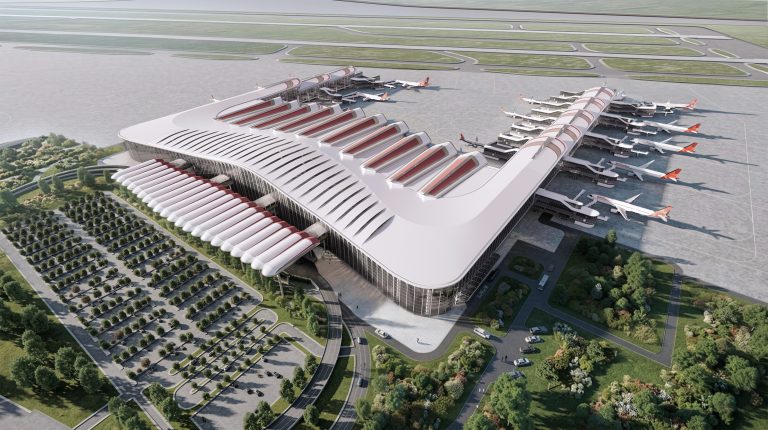
The integration of domestic and international transfer flows further enhances connectivity, reducing transfer times and improving the overall passenger journey. Commercial and retail functions are strategically embedded along the departure concourse, creating an active and engaging pre-flight environment while maximising non-aeronautical revenue opportunities.
Flexibility is another defining feature of the design. The terminal layout is conceived to accommodate evolving operational needs, with adaptable spaces that can respond to future changes in passenger volume, airline requirements, and technological advancements. This ensures that the airport remains relevant not only at the point of opening, but throughout its lifecycle.
Building for Growth and Resilience
The Phú Quốc International Airport expansion is planned as a phased development that balances immediate capacity requirements with long-term growth. Phase 1 of the project will accommodate up to 20 million passengers per annum by 2030, with future expansion phases increasing total capacity to 50 million passengers by 2050.
Designed to meet ICAO 4E standards, the airport can handle both narrow-body and wide-body aircraft, positioning it as a competitive regional hub within Southeast Asia. The integration of Multiple Aircraft Ramp System (MARS) stands further enhances operational flexibility, allowing the airport to adapt to varying aircraft configurations and airline demands.
Sustainability is addressed through climate-responsive design strategies that respond to Phú Quốc’s tropical climate, marked by distinct rainy and dry seasons. The structure and façade are engineered to withstand strong winds, while landscaped areas are designed to endure heavy rainfall and intense sunlight. At the same time, the façade remains intentionally open to maximise natural light and outward views, maintaining a seamless visual connection between the terminal and the surrounding island landscape.
Smart Systems and Seamless Journeys
Beyond its symbolic value, the airport’s transformation is underpinned by the integration of advanced technologies that enhance operational efficiency.
The passenger journey is designed to be seamless from arrival to departure. At the outset, the check-in concept reflects a forward-looking approach, with approximately 60% of counters dedicated to self-service, and the flexibility to increase this proportion in future phases. Biometric-enabled passenger processing is integrated at key touchpoints to significantly reduce waiting times and enhance efficiency.
Security screening processes are carefully streamlined to minimise duplication, allowing passengers to move intuitively from check-in through to departure gates. Beyond this, advanced baggage handling systems ensure the efficient movement of luggage throughout the terminal, supporting smooth operations behind the scenes.
Boarding gate configurations and apron planning are similarly designed for efficiency and scalability, enabling the airport to accommodate different aircraft types and operational scenarios while maintaining a consistent passenger experience.
Together, these systems reflect a shift towards airports as integrated digital environments, where technology enhances both operational performance and passenger experience.