

Asset Optimisation
Optimise to maximise
Every building owner wants to maximise the value of their property. There are opportunities to do so at every stage of a building’s lifecycle, even as the building ages and deteriorates.
Asset optimisation uses proactive strategies to enhance utilisation, efficiency and overall performance of a building. When done well, this can help preserve or even increase a building’s value, achieving peak returns for building owners.
At CPG, we achieve this in two primary ways: by optimising spaces and structures through adaptive reuse, and by optimising building operations to maximise Net Operating Income.
Optimising space & structures
There are many instances where buildings have outlived their purpose but not their lifespan. In a sustainability-first world, the traditional demolish-and-rebuild approach, which creates an outsized carbon footprint, needs to be replaced with an adaptive reuse mindset.
Adaptive reuse is an effective asset optimisation strategy that involves repurposing existing buildings, whether this is motivated by new spatial needs, stronger sustainability performance requirements or conservation reasons.
Assessment & Evaluation
Our ongoing research into adaptive reuse is anchored on different typologies, from heritage buildings to ordinary ones like offices, schools and more. In particular, we believe that the adaptive reuse of ordinary buildings holds significant potential as a mainstream development strategy that can have a positive, widespread effect.
Our research-driven approach has already led to the development of a proprietary evaluation tool that can perform high-level assessments of office buildings, scoring them for their conversion potential to residential or hotel use. This allows for easy benchmarking and helps building owners and developers to understand where they stand in comparison to other buildings.
Design & Implementation
Focusing on the conversion potential and new spatial needs of the building, our adaptive design work is highly tailored to each project.
Our overarching philosophy is to achieve a visible, positive transformation that reflects the building’s new identity and function while retaining familiar features to reinforce the sense of place within a neighbourhood.
For heritage buildings, it is essential that we start with a deep understanding of its historical and architectural significance. This ensures that any new design interventions we introduce are done in a sensitive manner while fulfilling their new functions.
Some of our adaptive reuse projects include Singapore icons such as National Gallery Singapore, NUS School of Design & Environment (SDE) 1 & 3 and Old Hill Street Police Station, among many others.
Optimising operations
During the operational lifespan of a building, owners should strive to maximise Net Operating Income by increasing revenue and decreasing cost. This can be achieved in several ways:
Leasing & Marketing
Preventive Maintenance
Customised preventive maintenance programmes that are designed to catch potential equipment failures before they occur. This builds greater resiliency into buildings while reducing operational downtime and repair costs.
Day-to-day facilities management can also be optimised with our digital maintenance management system. The system automates and streamlines maintenance processes, manages maintenance schedules, tracks equipment history, and generates maintenance reports accurately and efficiently.
Featured Projects
National Gallery Singapore
To create the National Gallery Singapore, we transformed the former Supreme Court and City Hall buildings into a modern art gallery while retaining the character and ambience of the historic structures.
NUS School of Design & Environment 1 & 3
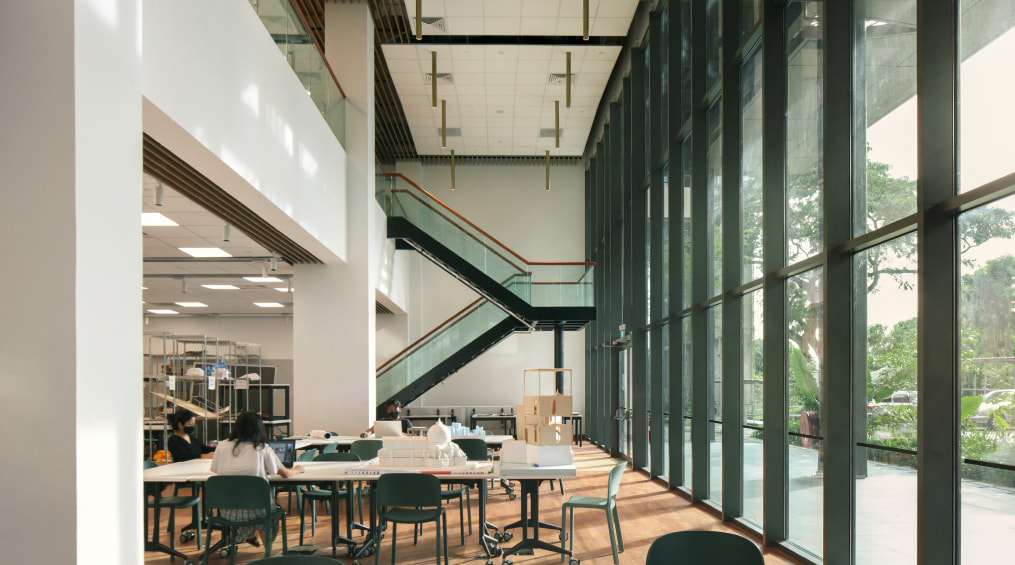
We took the original structures of the NUS School of Design & Environment 1 & 3 and turned the space from an old institutional building into a super-low carbon and net-zero energy academic environment.
Old Hill Police Station
For the Old Hill Street Police Station, a gazetted national monument in Singapore, we revitalised the space, restored key architectural elements and incorporated modern amenities to enable it to house the offices of two government agencies today.


