
Q&A with Lee Adam: Building a Flood-Ready Future for Singapore

As the impact of climate change becomes more visible and pressing, the role of climate resilience in built environment design is more critical than ever. In Singapore, where heavy rainfall and rising sea levels pose increasing risks, new national efforts are underway to protect lives, property, and infrastructure.
One such initiative is the Alliance for Action (AfA),recently launched by PUB, Singapore’s National Water Agency. The committee will work together to co-create, as the first effort, a Flood-Resilient Developments (FRD) guidebook that owners can use to enhance the resilience of their premises against inland and coastal flooding, and as a second push, help guide, from an expert perspective, the creation of Singapore’s first Code of Practice for coastal protection on coastal protection. The AfA brings together the expertise of key players from across the built environment sector to co-develop practical flood protection strategies tailored to Singapore’s dense urban context.
We sat down with Lee Adam, Head of the Climate Resilience Studio at CPG Consultants and newly appointed committee member of the Alliance, to hear more about what this means for the industry, and why now is the time to be flood-ready.
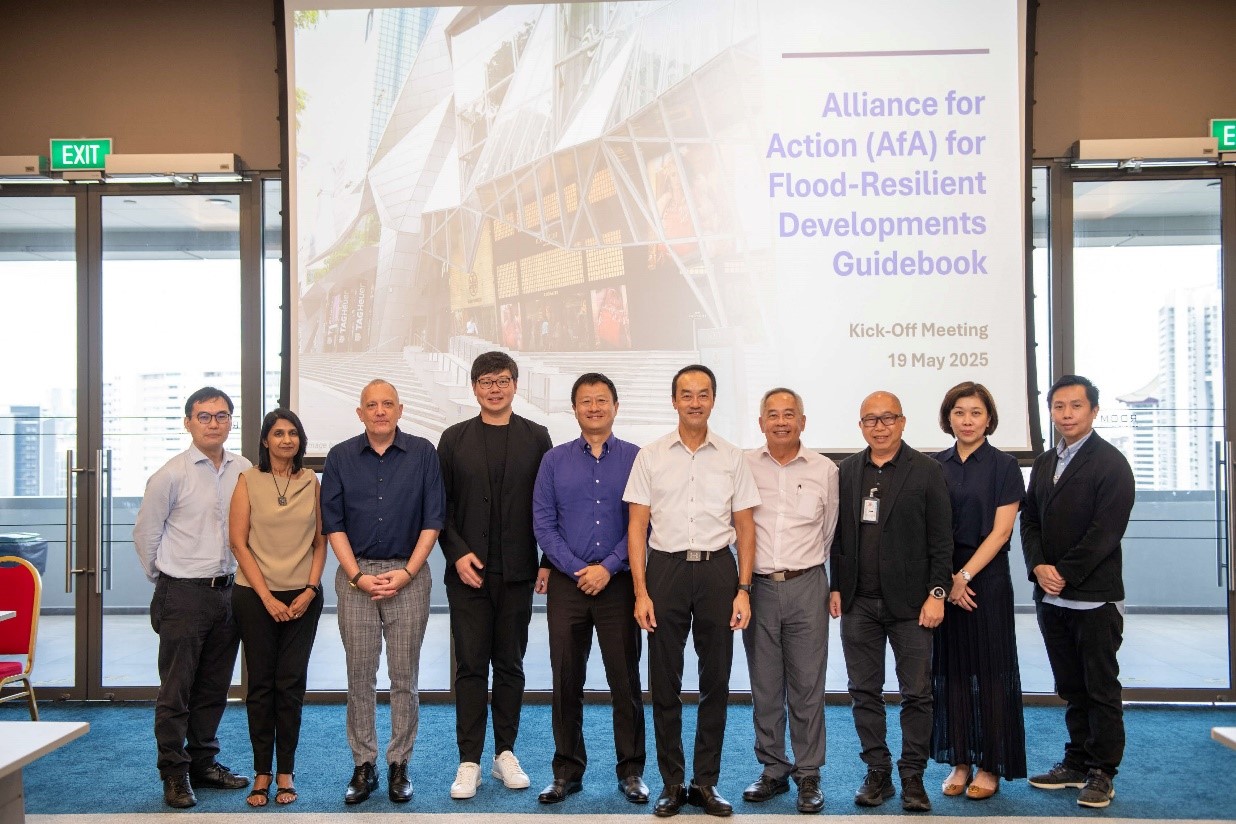
Dr Koh Poh Koon, Senior Minister of State for Sustainability and the Environment with members of the AfA at the kick-off meeting on 19 May. From left to right: Dillon Lim, Sunita Dass, Lee Adam Harryman, Melvin HJ Tan (co-lead), Ong Tze-Ch’in (co-lead), SMS Koh Poh Koon, Lim Peng Hong (co-lead), Richard Lai, Jee Yi Yng, Nicholas Loh. (Not in the photo: Chan Ewe Jin, Lee Tuck Wai)
Photo and Caption Credit: PUB
Q: First, congratulations on your appointment to the AfA. Could you tell us more about the role of this Alliance and what your involvement entails?
Lee Adam: Thank you. The Alliance for Action is a cross-sectoral initiative that brings together developers, consultants, regulators, and academia to co-create strategies for flood-resilient building design.
As part of the Government’s expert working committee, I contribute industry perspectives on how coastal flood protection can be meaningfully embedded into both new and existing developments. This is aided by expertise from CPG’s Climate Resilience Studio, which has been involved in a range of water-sensitive and flood mitigation projects. These include coastal and inland flood risk assessments for major institutions and industrial estates, consultancy for integrated ‘blue engineering’ master planning, as well as pioneering blue-green infrastructure solutions for parks and precincts such as our award-winning Bidadari Park. Our team has also contributed to the development of coastal and drainage design guidelines and supported feasibility studies that link climate data with urban planning. Most notably, CPG led the very first site-specific study for the City-East Coast (Changi, East-Coast Marina, Greater Southern Waterfront), which started in 2021.
We’re not just discussing broad policy directions; we’re rolling up our sleeves and looking at implementation-level challenges and opportunities.
Q: In your recent LinkedIn post, you mentioned helping the industry become flood-ready. Can you explain what that means in practical terms?
Lee Adam: In my opinion, being flood-ready is about moving from awareness to action. It’s not just a slogan, but a shift in thinking. It means designing and planning developments that anticipate sea level rise coupled with extreme weather events, something we in the industry term joint-probability’, and are equipped to handle them without major disruption. This could mean elevated platforms, integrated drainage solutions, site-sensitive layouts, and adaptive infrastructure. The goal is to protect not just property, but people and daily operations.
Q: What are some of the key challenges in making Singapore’s buildings more flood-resilient?
Lee Adam: Space is one of the biggest constraints. In a dense urban environment like Singapore, you don’t always have the luxury of wide buffers or large retention zones. That’s where innovation and integration come in. We need to make resilience work within the tight parameters we’re given.
Another challenge is stakeholder alignment. Developers, consultants, and owners all need to be on the same page about long-term climate risks. This includes balancing short-term cost concerns with long-term resilience outcomes. Public education, regulatory support, and targeted incentives will be key.
Q: What excites you most about this new role and the road ahead?
Lee Adam: I’m excited by the opportunity to make a real, practical difference. Climate resilience is no longer theoretical. We’re seeing the effects around us, and we have a narrow window to adapt. Being part of the AfA allows me to work alongside like-minded professionals and policymakers who are committed to getting this right.
It’s also gratifying to be able to bring CPG’s deep experience into the conversation. We have long been involved in many projects that already incorporate elements of resilience, this is about scaling that mindset across the industry.
Q: What would you have to say to industry peers who are also keen on climate resilience?
Lee Adam: Start early. Resilience should not be an afterthought. Engage your consultants, study your site, and think long-term. And don’t be afraid to test new ideas. As an industry, we’re learning together, and collaboration is what will get us where we need to be.
To learn more about how CPG is addressing climate resilience in practice, read our blogposts:
Building a Resilient Future: CPG Climate Resilience Team
Embracing Nature-Based Solutions in Singapore for Sustainable Water Resilience