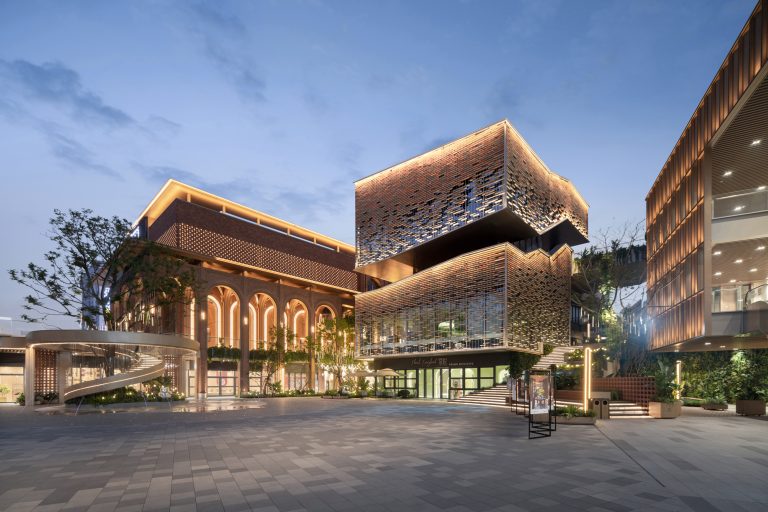
Chongqing “City of Inspiration”: A TOD District Blending Transit and Culture
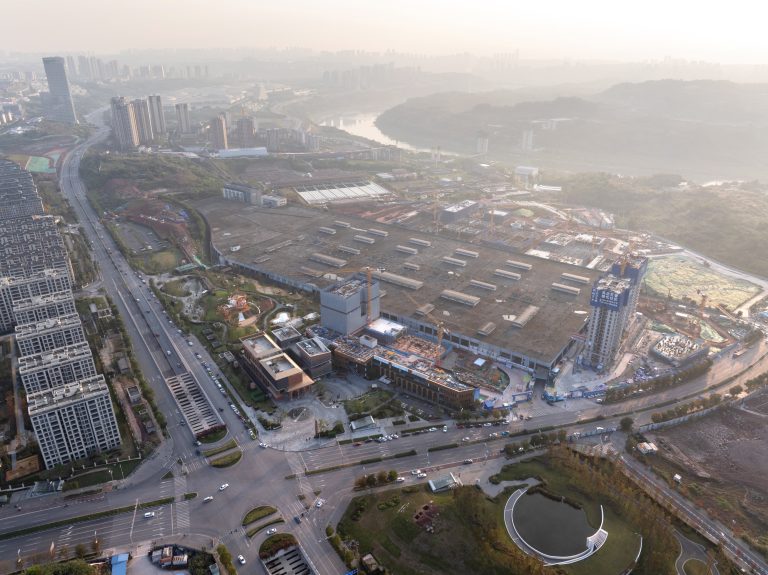
Beside Wangjiazhuang subway station in Chongqing’s Yubei District, a new type of community is taking shape. “City of Inspiration” (重庆之丘) is more than a development project. It is a vision of how transit, commerce, and community can converge to create a new way of urban living. Conceived as a pioneering Transit-Oriented Development (TOD), it integrates housing, retail, office, and transport functions into a holistic neighbourhood that reshapes lifestyles and supports regional growth.
Entrance aerial view of the City of Inspiration
TOD is not a new concept, but in fast-growing Chinese cities it is gaining momentum as a sustainable approach to development. By clustering activity around major transport nodes, TOD projects reduce dependence on cars, encourage walkability, and create vibrant urban centres. What sets Chongqing apart is its dramatic topography and cultural depth, both of which are qualities that give this project both complexity and unique character.
From Hillside to Vertical Garden
The site was once a stretch of rolling hills. The design team from CPG and China Construction Technology Consulting Group sought to preserve this natural character, allowing the new district to retain the memory of the land. Rather than level the terrain, the masterplan follows its contours, creating multi-level spaces with nearly 20 metres of height difference between entrances to the metro, residences, and commercial areas.
Three-dimensional garden district
These variations are woven together into a three-dimensional garden district, where winding pedestrian paths and layered green terraces create a sense of discovery. Walking through the neighbourhood feels less like moving through a commercial development and more like exploring a natural hillside, one where greenery, architecture, and daily life intertwine.
Strolling through the hills
This blending of the natural and urban reflects an ambition to offer not just housing or retail, but a living experience that echoes the rhythms of Chongqing itself.
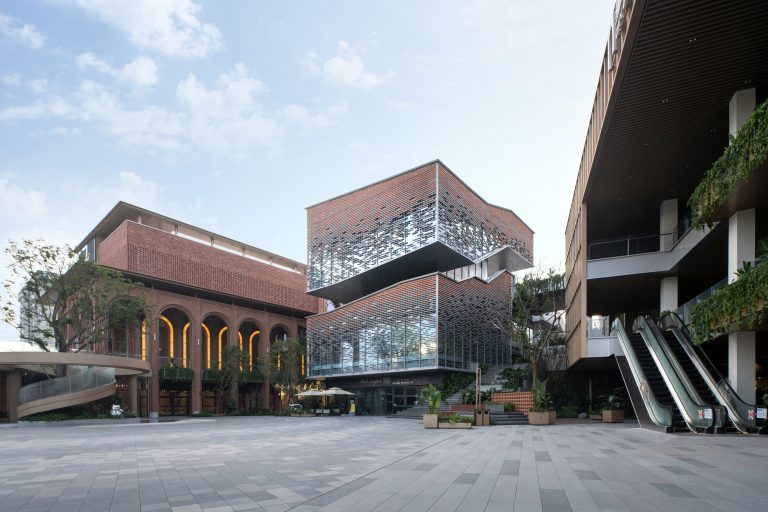
Plaza space
A Dialogue Between Tradition and Modernity
Chongqing is a city steeped in history yet alive with contemporary energy. The architecture mirrors this duality by combining traditional motifs with modern forms. Facades and details reference local culture, while the overall design language is distinctly forward-looking.
South-facing elevation
A dialogue between tradition and modernity
Each building has its own unique identity, yet all harmonise within a coherent whole. Together, they create a streetscape that is as diverse as it is unified, an urban tapestry that reflects both the weight of tradition and the vibrancy of modern Chongqing.
The Arch and the Water Channel
Among the project’s defining features is the arch, inspired by the arched water channels that once crossed the site. In Chongqing, these are more than feats of hydraulic engineering, they are cultural markers of resilience and continuity.
The design reinterprets the motif in multiple ways: from classic cross-vaults and continuous arches to bold sculptural forms. Some evoke the past directly; others push into new territory, creating spatial experiences that feel both familiar and surprising.
Restored water channel landscape
Executed in modern materials and techniques, these arches embody the project’s broader vision: bridging history and modernity, tradition and innovation. Each arch becomes a frame, not just for space, but for memory and imagination.
A Flowing Facade
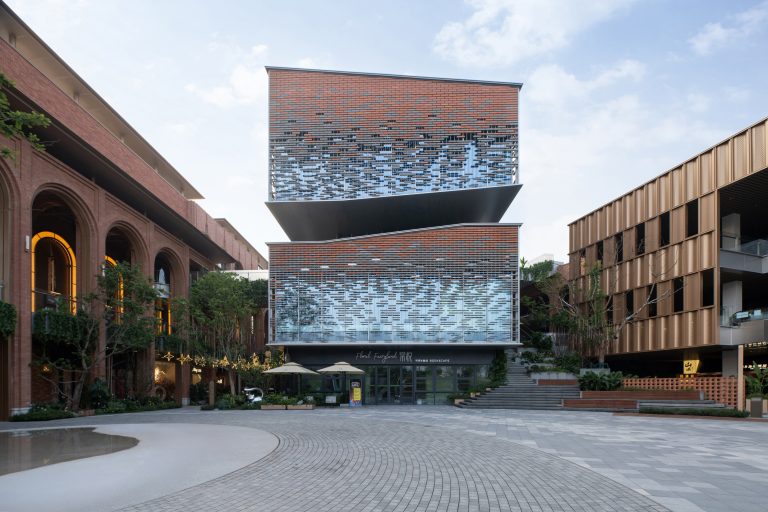
Chongqing is also known as a river city. With the Jialing River to the west and Zhuchang Creek to the east, it was natural for water to inspire the design. The bookstore’s façade, a landmark of the project, embodies this connection.
Waterflow Effect on the Storefront Façade
Suspended metal bricks, finished to resemble ceramic, are arranged in gradients of size, density, and colour to create the impression of cascading water. The result is both poetic and functional: the façade ripples with movement while allowing natural light and ventilation into the interiors.
Water motif on the bookstore façade
In this gesture, the building becomes more than structure, but more like landscape, embodying the spirit of the rivers that shape the city.
Imagery of morning sunlight and flowing water
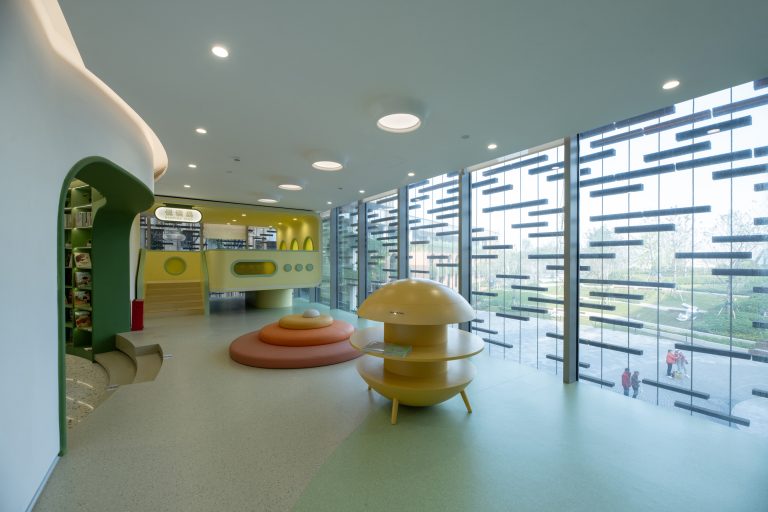
Inside the bookstore
The Warmth of Street Life
Inspired by Chongqing’s storied lanes and alleys, the design introduces streets and plazas at multiple scales, creating an environment that feels intimate and human. The central bookstore stands as a “town pavilion,” anchoring the district, while the sunken plaza and garden terraces provide everyday spaces for encounters, conversations, and leisure.
Bookstore plaza at nightfall
Here, commerce blends with community. The bustle of urban life is softened by moments of pause, where neighbours meet and relationships take root. In this way, the project reclaims the social qualities of the traditional street, reinterpreted for the twenty-first century.
A Prototype for the Future
“City of Inspiration” aspires to be more than a model for future residential communities. It represents a fusion of nature with modern urban living—a place where geography, history, and innovation coalesce.
By combining transit integration, sensitive design, and cultural resonance, the project sets a benchmark for how TOD districts can be more than functional. They can be inspirational. It is envisioned as the neighbourhood’s favourite destination, where residents can relax, socialise, and rediscover the sense of belonging that makes a city truly alive.